

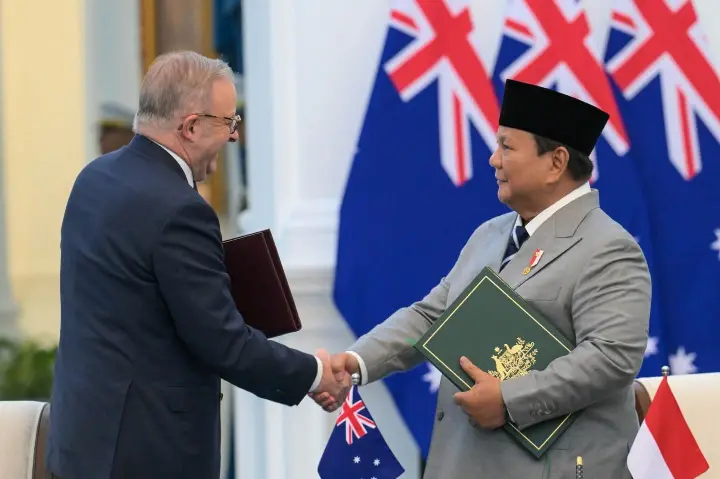
JAKARTA & CANBERRA — Geography, as Napoleon once remarked, is the only destiny. For Indonesia and Australia, two neighbors separated by a shallow sea but long divided by deep-seated suspicion, that destiny has just taken a legal turn. In Jakarta on February 6th, President Prabowo Subianto and Prime Minister Anthony Albanese signed a “Joint Security Treaty.” It is a document that signals the end of decades of tactical flirting and the beginning of a strategic marriage of necessity.
For Canberra, the treaty is a vital northern anchor in an increasingly choppy Indo-Pacific. For Jakarta, it is a masterclass in its “independent and active” (bebas-aktif) diplomacy—proving that one can sign a security pact with a key American ally without becoming a pawn in Washington’s game.
Beyond the “Lombok” Legacy
The relationship has come a long way since the 2006 Lombok Treaty, which was largely focused on non-traditional threats like people-smuggling and cattle trade. This new pact is meatier. It moves beyond mere cooperation into a structured framework for defense, intelligence sharing, and joint maritime security.
President Prabowo, a former general who understands the language of power, framed the pact as an act of “good neighbourliness.” Yet, between the lines, the message to Beijing is unmistakable: Southeast Asia’s largest economy and the continent-state to its south are no longer willing to let their strategic interests be managed by others.
Strategic Audit: The Jakarta-Canberra Security Axis
The treaty marks a shift from ad-hoc military drills to a formal commitment, creating a “security shield” that sits at the very heart of the world’s most contested maritime corridor.
The Verdict
For Australia, the treaty is a triumph for the Albanese government, securing its closest and most populous neighbour as a formal security partner. For Indonesia, it is a bold experiment in pragmatism. President Prabowo is betting that he can maintain the delicate balance between Beijing’s investment and Canberra’s protection.
The real test, however, will not be the signing ceremony in Jakarta’s heat, but the next time tensions flare in the South China Sea. Will this treaty provide a solid shield, or will it crumble under the weight of competing regional interests? For now, at least, the “Southern Comfort” of a shared security vision has made the Indo-Pacific look just a little bit more stable.