
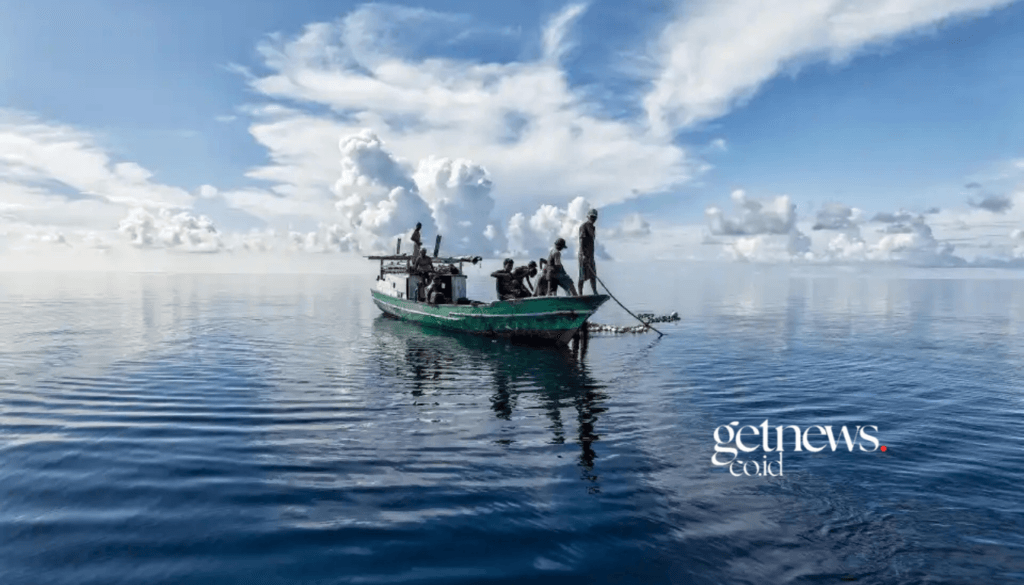
MATARAM IS engineering a quiet but forceful pivot in its coastal economic strategy. In the first year of the administration of Lalu Muhamad Iqbal and Indah Dhamayanti Putri (Iqbal–Dinda), West Nusa Tenggara (NTB) has ceased to view its oceans as merely a blue expanse for extracting primary commodities. The year 2025 has become a crucible for structural transformation, where a staggering production volume of 1.25 million tons is no longer the final objective, but rather the high-octane fuel for an “agro-maritime” industrial engine that is finally being fired up.
The prevailing narrative in Jakarta and Mataram has shifted from “extraction” to “value-added clusters.” The rise of the Fisheries Terms of Trade (NTP) to 106.82 is a critical indicator that economic efficiency is finally reaching the households of local fishermen and aquaculturists. However, the true litmus test for the Iqbal–Dinda vision lies in the successful transition from raw material exports to domestic value creation—a leap that began with the operationalization of the Bima salt factory and continues with the ambitious plans for integrated shrimp processing hubs.
Strategic Audit: NTB Maritime Economy Consolidation 2025
This analysis dissects the equilibrium between soaring production output, the economic resilience of stakeholders, and ecological sustainability.
Regulation as an Economic Shield
The enactment of Provincial Regulation No. 14 of 2025 is far more than an administrative exercise. It is a formal assertion of NTB’s sovereignty over its 12-nautical-mile maritime zone. By strengthening risk-based licensing, the provincial government is filtering incoming investment: only capital that respects ecological carrying capacity is granted permission to dock. The management of 12 marine conservation areas through three Public Service Agencies (BLUD) proves that ecosystem protection is no longer a “cost,” but a long-term investment to ensure the sustainability of seaweed and shrimp production.
The Shrimp Paradigm and Bima’s Industrial Future
The government’s move to prepare Feasibility Studies (FS) and Detail Engineering Designs (DED) for an integrated shrimp processing plant signals the end of the “raw shrimp export” era. By offering fiscal incentives and land facilitation, Iqbal–Dinda are attempting to entice capital to settle longer in NTB. If this processing facility is realized, the shrimp value chain—traditionally captured by factories outside the province—will be locked within NTB, creating jobs for thousands of coastal youths.
Strategic Verdict:
The first year of Iqbal–Dinda has successfully planted the “seeds” of regulation and infrastructure. However, Sante, Lur! (Stay chill, Folks!) Transforming a maritime economy does not happen as fast as pulling a net from the sea. The greatest challenge for the coming year is ensuring that the shrimp processing plant investment does not remain merely a paper exercise. The success of salt downstreaming in Bima is a proven blueprint; now the public waits to see if similar success can be replicated in shrimp and seaweed to crown NTB as the agro-maritime giant of Eastern Indonesia.
FURTHER READING:
The $38 Billion Handshake: Is This Peace or a Subscription Fee?