

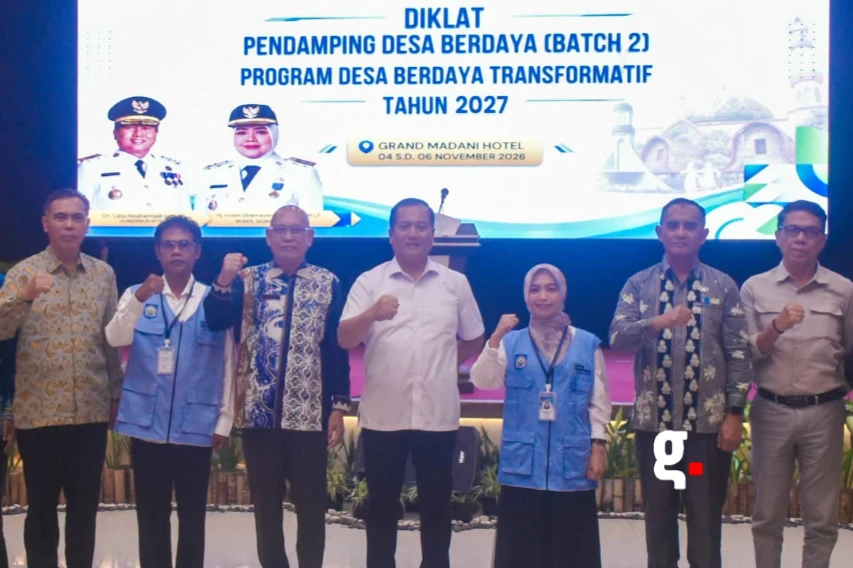

Field-level mentoring and data accuracy face a critical test in West Nusa Tenggara’s poverty alleviation campaign.
The integration of active field assistance and rigorous data verification is shaping up to be the ultimate test of West Nusa Tenggara’s (NTB) commitment to eradicating extreme poverty across its rural communities.
The recent deployment of 140 Transformative Empowered Village Assistance Officers (Pendamping Desa Berdaya Transformatif Batch 2) by NTB Governor H. Lalu Muhamad Iqbal underscores a classic governance challenge: bridging macro-level poverty reduction targets with complex ground realities.
As reported by <a href=”[https://suarantb.com/2026/11/06/harus-hadir-di-tengah-masyarakat/](https://suarantb.com/2026/11/06/harus-hadir-di-tengah-masyarakat/)” target=”_blank” rel=”noopener”>Suara NTB</a>, with NTB’s general poverty rate standing at 11.17 percent and extreme poverty measured at 2.0 percent as of June 2026, program effectiveness is no longer evaluated through high-level target setting, but rather by the ability of field officers to directly intervene in the lives of the province’s most vulnerable households.
The cornerstone of this refined approach relies on a clear bifurcation of field strategy:
- Productive Households: Economic self-reliance and micro-enterprise development are prioritized to build sustainable income streams.
- Non-Productive Households: For elderly citizens and individuals with chronic illnesses, guaranteed long-term social safety net protections remain mandatory.
A significant data audit—which narrowed the initial target of 10,848 extreme poor households down to 6,567 verified candidate families (a 60.5 percent qualification rate)—highlights the critical role of physical validation in eliminating ghost targets and avoiding misallocated fiscal aid.
Strategic Audit: NTB Empowered Village Program
| Key Performance Indicator | Operational Status | Strategic Risk Assessment |
|---|---|---|
| Extreme Poverty Data Validation | 60.5% Adjustment (High Precision) | 6,567 families verified from initial 10,848 target; mitigates misallocation caused by migration and double-counting. |
| Field Intervention Strategy | Adaptive Segmentation | Clear bifurcation between self-reliance economic tracks and full social protection coverage. |
| Inter-Agency Village Integration | Critical (Coordination Bottleneck) | Risk of sectoral silos between Village Apparatus, Posyandu Cadres, PKH Officers, and Village Assistance Teams. |
Mitigating Bureaucratic Inertia at the Grassroots
The long-term viability of the Empowered Village framework relies heavily on seamless cross-sector collaboration at the community level—uniting village apparatuses, Posyandu health cadres, Family Hope Program (PKH) facilitators, and local military village supervisory officers (Babinsa).
Without breaking free from administrative routine, field officers risk being reduced to mere document collectors rather than active catalysts for grassroots economic transformation.
GET INSIGHT Team