

IF THERE IS one venture promising profit margins more delirious than crypto-speculation or hawking iced tea in a perennial drought, it is the business of cultivating enemies.
According to the annual report of the Ministry of Peace—that phantom institution which de facto orchestrates the Washington-Tel Aviv axis—economic growth remains a sturdy 7%, provided that ballistic missiles continue to be forged and plummeted into the Middle East. In this theater, Orwellian dogma is practiced with literal devotion: War is Peace. Fear is Capital. Oil is Blood.
At the apex of this power pyramid sit two swine—to borrow a trope from Animal Farm—now draped in Brioni tailoring and silk neckties. The first is The President (let us call him Mr. D), a golden-crested former real-estate tycoon who perceives geopolitical maps as mere Monopoly boards. The second is The Prime Minister (Mr. N), a war-architect obsessed with distending his backyard until it consumes the shifting borders of a “Greater Homeland,” interpreted from the dust of ancient parchments.
Their shared vision is singular: to seize the golden wells of Persia and expand territorial perimeters ad infinitum. The conundrum, however, remains: how does one invade a sovereign state that refuses to strike first? Here, the 1984-style political genius manifests. You do not wait for the attack; you manufacture it.
Daily, signals of diplomacy emanate from Persia, the Levant, and the Cedar Hills. Yet, each time a ceasefire proposal is laid upon the mahogany, a “mysterious terrorist strike” conveniently erupts at the frontier. Suddenly, a ghost drone strikes a vacant outpost; a tanker spontaneously combusts. On the silver screen, Mr. D and Mr. N stand with rehearsed solemnity, condemning the “axis of evil” while demanding supplemental defense appropriations. Fear, it seems, sells far better than bread. They will never permit a quiet world; for a world at peace is a world where defense stocks plummet and annexation projects wither.
Yet, within this cold, gargantuan machinery, there is always a loose screw. Her name is Sarah.
Sarah, a senior data analyst at the Pentagon, carries the lineage of Holocaust survivors who taught her the visceral weight of “Never Again”—that oppression is a ghost to be exorcised, not a shield for oppressing others. By day, she monitors anomalies in Middle Eastern airspace. By night, via encrypted chess servers masked by layers of VPNs, she falls in love with Arash.
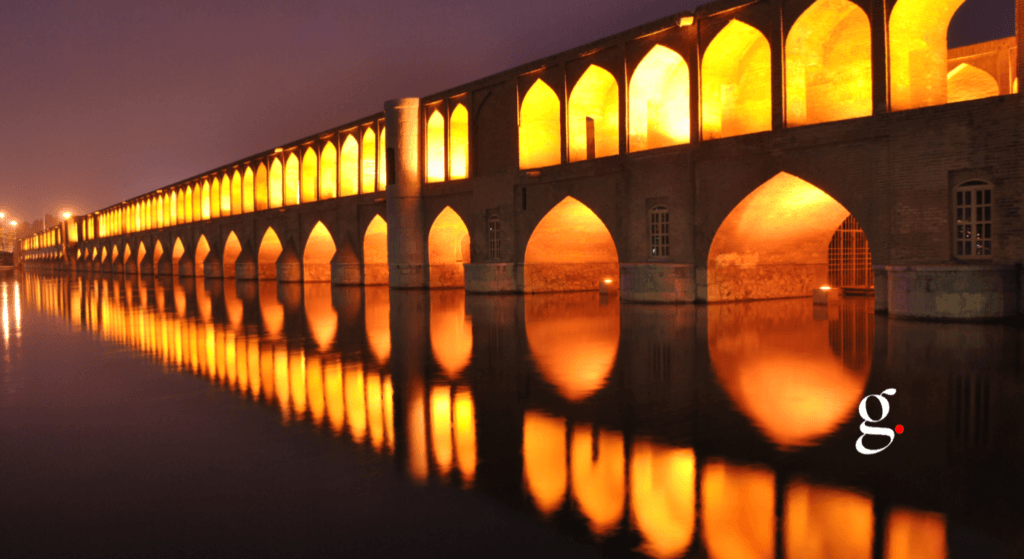
Arash is no extremist. He is a civil engineer and a part-time poet in Isfahan who prefers the structural elegance of the Si-o-se-pol bridge and the verses of Hafez to the sterile mechanics of uranium enrichment. Their cross-border liaison is the ultimate modern sedition. They are Winston and Julia in a digital panopticon; two souls attempting to nurse sanity amidst the doublethink fed by the state apparatus every dawn.
“If they knew I loved a Persian,” Sarah typed one evening, her screen illuminating a weary face, “they would diagnose me with radicalism.”
“Then I shall reply with a sonnet,” Arash countered. “So they may learn that a verse from Isfahan is far more lethal than a nuclear warhead.”
Their love survived on strands of binary code—until a Tuesday when the algorithms on Sarah’s desk caught a jagged glitch.
Mr. D and Mr. N had finally greenlit “Operation Holy Storm.” The gambit was classic: fire a ballistic missile at one of their own decommissioned carriers in the Persian Gulf, then forge the radar signatures to make it appear as if the strike originated from Isfahan. It was the perfect casus belli to level Iran, occupy its oil fields, and finalize the map.
Sarah saw the metadata that could not lie. The missile was not Persian. It was a false flag, a lie meticulously engineered by her own government. With trembling hands, she committed high treason. She opened her encrypted channel for the final time.
“Arash. Listen to me,” the message surged through undersea fiber-optics. “It’s a trap. They need a reason to enter. Tonight, the skies of Isfahan will not be safe. Run, Arash. Take your family. Get away from the city center!”
In a room cluttered with weathered books and architectural blueprints, Arash read the warning. But for Arash, flight was a form of spiritual desertion. Isfahan was not a mere coordinate on a radar screen; it was his ancestral bedrock. Within every brick dwelled the scent of saffron and the sweat of forefathers who built a civilization. His love for his soil was rooted as deep as an olive tree, unshaken by the gathering storm.
“Sarah, my love,” his reply appeared three minutes later. “I will not run. If the greedy old men of your nation wish to raze my birthplace for oil and maps, let me stand here. I shall welcome the end amongst the buildings I raised and the poems I penned. The dignity of a nation and the worth of a man are not measured by the speed at which he flees his home.”
Sarah wept, typing in a frenzy of pleas. But the screen went black. Not a connection error—the alarms at the Pentagon had signaled. Her door was breached by six expressionless men in internal security blacks. They did not shout. They simply severed the power, seized the hardware, and dragged Sarah from her chair. Arrested for “Treason against National Security.” In an Orwellian world, speaking the truth is the ultimate sedition.
That night, the missiles sang. The Isfahan sky ignited—not with stars, but with white phosphorus and warheads funded by taxpayers who believed they were purchasing peace. Arash’s apartment, the sanctuary where he refused to bow, dissolved into ash along with his verses. Mr. D and Mr. N secured their prize: a profitable war, a pretext for plunder, and a new map traced in blood.
The following morning, the financial wires released a report—analytical, cold, and detached: “Markets respond positively to the latest military intervention in the Middle East. Defense contractor equities surged 15%, while crude oil prices stabilized following aggressive coalition securing.”
No one wrote of Arash’s patriotism as he stood his ground. No one wrote of Sarah, held in a nameless black site, staring at concrete in silence. In the eyes of the State, their love and their truth never existed. Their story was merely noise—a minor data anomaly successfully purged from the grand algorithm of Power. History, after all, is written by those who press the launch button, not by those who write love poems.