
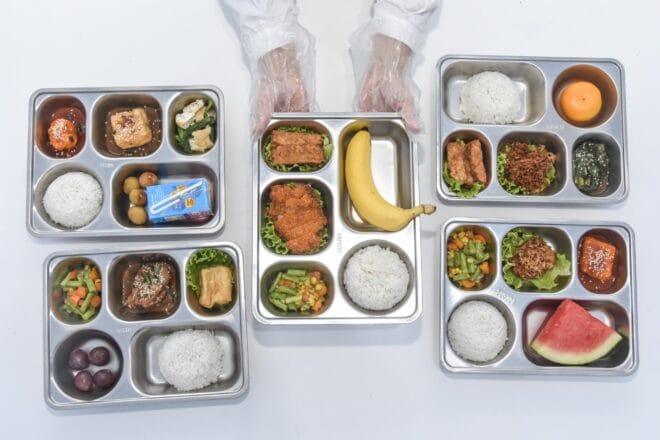
Free Nutritious Meals (MBG) aims at raising nutritional standard of students and keeping them focused in studying.
GETNEWS – President Prabowo Subianto brought the Free Nutritious Meals (MBG) Program for millions of Indonesian students. Various reactions to the meals in several areas serve as reminders of the need for strict supervision and collaboration from multiple parties to ensure this program truly provides benefits.
The implementation however is not always easy. The public’s attention was drawn to the contamination issue, leading stakeholders to call for an evaluation.
Parahyangan University’s deputy dean of social and political sciences faculty Kristian Widya Wicaksono, Ph.D. argues that a program as massive as MBG cannot be run only by one central agency. According to him, success lies in collaboration. “Large-scale programs require people-oriented administration. We need multi-stakeholders including from local governments and schools to local communities,” explained Kristian.
He gave an example from the City of Bandung, where the urban village administrations involved in distribution. “They possess valuable on-the-ground experience. If they had been involved from the beginning, the results would certainly be smoother,” he added.
Kristian emphasized that local networks are an asset. Infrastructure may be limited, but social networks at the village and urban village level can smooth the implementation.
Meanwhile, the House of Representatives’ Commission X Deputy Speaker Lalu Hadrian Irfani highlighted that a comprehensive evaluation is essential. “This program must continue, but regions with contamination cases, like Garut, require immediate evaluation,” he said on Thursday, Sept. 25.
He highlighted the risky food distribution pattern. “There are kitchens that start cooking at one in the morning, then only distribute at eleven in the morning. That 10-hour delay is hazardous. There must be a label of “fit for consumption”, a seal, and clear distribution rules,” he stressed.
For Lalu, teacher’s role is also essential in detecting early problem.
He also emphasized a collaboration between the National Nutrition Agency (BGN), local governments, and schools. According to him, it is not enough to rely only on recipient data from the education office.
“BGN must be transparent and involve all parties, including teachers and parents. Do not wait for students to get sick before taking action,” he stated.
Lalu also emphasized that Commission X will continue to oversee MBG because part of its budget comes from the education post. “We want to ensure that this program is truly beneficial, not create new problems,” he said.
Both academics and parliamentarians agree: the key to MBG’s success lies in collaboration. Local governments with their local networks, schools with their teaching staff, and central agencies with their budget must work together.
Kristian reminded everyone that governance is the foundation. “Without effective governance, loopholes for problems will always exist. But, many parties involvement from the beginning can reduce the risks,” he said.
He emphasized the great goal of the program. “The President’s intention is very noble, which is to prepare the Golden Generation of 2045. Do not let it be tarnished just because of weak supervision,” he concluded.
MBG program is an investment in the future. It is not just about serving food on students’ tables, but about sowing hope so that every Indonesian child grows up healthy and intelligent. Challenges do exist, but with cross-sector collaboration, this program has the potential to be an important milestone in realizing the ideals of Golden Indonesia.
indonesia.go.id/Photo courtesy of ANTARA FOTO/Adeng Bustomi