
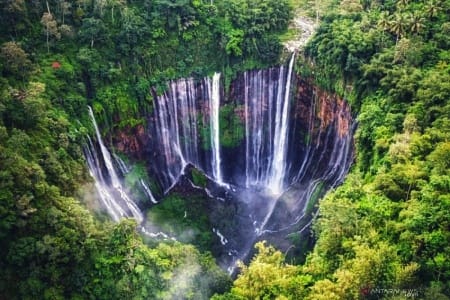
If you’re fortunate, you can witness a stunning rainbow phenomenon created by the refraction of sunlight as it interacts with the waterfall’s mist.
With the year-end holiday season approaching, why not consider exploring a natural gem in the southern part of East Java? Located on the border between Lumajang and Malang Regencies, this area offers unique attractions that are less well-known than destinations like Batu or Banyuwangi. One such hidden gem is the breathtaking Tumpak Sewu Waterfall.
Tumpak Sewu Waterfall is the perfect destination for travelers looking to unwind and immerse themselves in breathtaking natural beauty. According to the East Java Provincial Culture and Tourism Office, the waterfall is located between Sidomulyo Village in Pronojiwo Subdistrict, Lumajang Regency, and Sidorenggo Village in Malang Regency. Nestled within a steep valley, it sits at an altitude of 500 meters above sea level, on the slopes of Mount Semeru.
Also known by its alternative name, “Coban Sewu,” this stunning tourist attraction boasts a height of approximately 120 meters. Its impressive height, unique formation, and wide water cascade, resembling a giant curtain of water, have earned Tumpak Sewu the reputation as the most beautiful waterfall on Java Island.
The waterfall is fed by the Glidih River, which originates from Mount Semeru. The name “Tumpak Sewu” comes from Old Javanese, where “tumpak” means “Saturday” and “sewu” means “thousand.” The term “sewu” refers to the many streams of water that form the waterfall, which continue to flow consistently even during the dry season.
Due to its beauty, Tumpak Sewu is often referred to as Indonesia’s Niagara Falls. Similar to Niagara Falls, one of the largest and most famous waterfalls in North America, the water at Tumpak Sewu flows in a way that that creates a curtain-like cascade.
If you’re lucky, you might witness a mesmerizing rainbow phenomenon caused by the refraction of sunlight interacting with the waterfall’s mist, further enhancing the charm of this natural wonder.
For travelers heading to the waterfall, the entrance is about 400 meters away, which takes approximately 10 to 15 minutes on foot. It’s recommended to wear specialized hiking shoes, such as mountain boots or hiking shoes, to ensure better traction and prevent slipping.
On the way to the main viewing point, visitors will walk through footpaths lined with residents’ plantations and food stalls. Upon reaching the Tumpak Sewu Waterfall area, visitors are presented with two viewing options: the Tumpak Sewu Panorama spot or a descent down the cliff to the bottom.
The Tumpak Sewu Panorama spot offers the easiest and most accessible view of the waterfall. However, for those looking for a more adventurous experience, descending to the base of the cliff provides a more challenging route due to the slippery and steep path. Despite the difficulty, many tourists choose this route, driven by a desire to witness the beauty of Tumpak Sewu Waterfall from below.
Hiring a local guide is recommended for visitors who wish to explore the base, though it is optional. These guides not only help navigate the trail to Tumpak Sewu but also offer tours to nearby attractions, such as Telaga Biru (Blue Lake), Nirwana Cliff, and Goa Tetes (Drop Cave).
The Tumpak Sewu Waterfall is open daily from 7 a.m. to 5 p.m. WIB (Western Indonesian Time). As for how to get there, although the waterfall lies on the border between Lumajang and Malang Regencies, most visitors prefer the route through Lumajang. Travelers can take the National Road Route 3 along East Java’s southern coast to reach the Waterfall.
From Malang, tourists can follow the Bululawang-Dampit-Tirtomoyo-Pronojiwo-Malang-Lumajang border route, which takes about two hours. Upon arriving in Sidomulyo Village, Pronojiwo Subdistrict, visitors will find the entrance to Tumpak Sewu Waterfall. Travelers can park directly at the tourist site. The Tumpak Sewu Waterfall is easily accessible by private vehicles or public transport, such as minibuses from Malang or Lumajang.
Foto cover: An aerial view of Tumpak Sewu Waterfall in Pronojiwo, Lumajang, East Java. ANTARA FOTO/ Budhi Chandra Setia
indonesia.go.id