
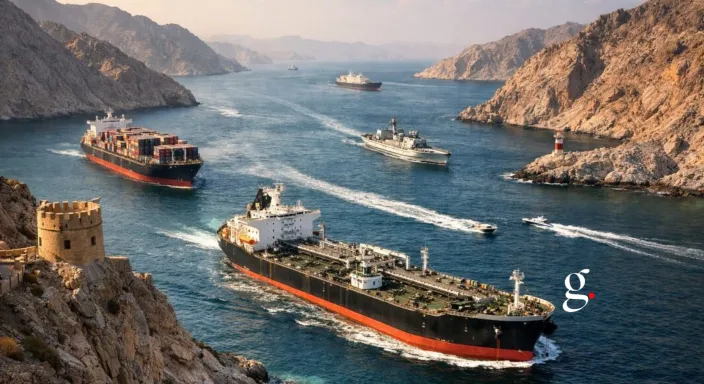
IF YOU WERE to ask any logistics calculator in the world, the Strait of Hormuz is the heartbeat of global trade. The shortest distance, the lowest cost. Yet, in the official release of this Republic’s Ministry of Maritime Truth, a detour of 8,000 nautical miles around the Cape of Good Hope, Africa, was suddenly heralded as the “Most Efficient Navigational Decision of the Century.”
Under the leadership of The General—a man of iron-jawed resolve whose posters are always positioned to face the rising sun—the nation had recently ratified its membership in the Board of Piss. This Council was the magnum opus of Mr. T, a blonde real-estate emperor from the West who defined “Peace” with chillingly Orwellian precision: Peace is the act of bombing those who do not align with Tel Viv and Pishington.
The fact that 90 percent of the Republic’s citizens vehemently rejected this pact, viewing it as direct complicity in the slaughter in the Olive Lands, was dismissed by the State as a mere statistical error. Million-man marches in the capital were broadcast on state television as “Carnivals of Global Solidarity.” Doublethink functioned with flawless grace: The General wore a keffiyeh scarf at the morning podium, then signed contracts for fighter jets and Persian oil embargos by nightfall. Jatavia’s reluctance to traverse Hormuz was not a tactical maneuver; it was fear, gift-wrapped in the silk of diplomacy.
Within this gargantuan machinery of hypocrisy, worked Bima.
Bima was a route analyst at the Directorate of Navigation. His daily penance was falsifying fuel consumption data, ensuring that the detour—which drained trillions from the taxpayers’ coffers—appeared profitable on paper. He was a compliant screw. At least, until he met Farahnaz.
Farahnaz was a maritime trade attaché from Hamadan, Persia. They met in secret at a dimly lit tea house in a corner of the Old Sunda Kelana Port—one of the few blind spots that had eluded the prying eyes of the Bureau of Harmony.
Their love grew over nautical charts spread across sticky wooden tables. Farahnaz, with dark eyes burning with resistance, never understood why a nation as vast as the Republic was so willing to kneel.
“You have the strongest navy on the equator, Bima,” Farahnaz whispered one night, clasping his cold hand. “Why does your General refuse to sail through Hormuz? Why let ships carrying aid for the Olive Lands rot in the harbor just because Mr. T forbids it? Join us. The Strait belongs to us—to the nations that refuse to be colonized.”
Bima looked down, staring at his cooling tea. “You don’t understand, Farah. In this country, courage has been privatized. The General fears Western sanctions. The Board of Piss demands absolute obedience. If we sail through Hormuz and reconcile with your people, they will choke us by the collar. Here, the voices of 90 percent are worth less than the signature of a blonde emperor.”
Their romance was a minor insurrection destined to be crushed.
The climax arrived in the third week of November. Farahnaz was reassigned to lead a clandestine cargo ship from Bandar Abbas, Persia. The vessel carried not only the cheap oil desperately needed for the Republic’s energy crisis but also medical supplies intended to be smuggled into the Olive Lands via Jatavia.
Farahnaz needed one thing from Bima: the patrol coordinates of the Republic’s corvettes in the Indian Ocean, so her ship could slip through without being detected by the Board of Piss radar.
For the first time in his life, Bima defied the State. Driven by love and the decaying remains of a conscience, he breached the Ministry’s servers. He sent a safe corridor—a narrow path where Farahnaz’s ship could slide through.
But Bima forgot that under the regime of the Board of Piss, the eagle eyes of the West never blink, and betrayal often comes from within one’s own home.
The surveillance algorithms caught the anomaly in minutes. Exactly as Bima pressed Enter, his apartment door was breached. Six nameless men in black fatigues dragged him from his chair. He was not taken to a prison, but to the Mind Evaluation Room—a windowless, sterile white void.
On a massive screen before him, interrogators forced him to watch a live feed. Farahnaz’s cargo ship had been intercepted in international waters. But what shattered Bima’s soul was not the missile from the destroyer Amerigo hitting the hull. What killed him slowly was the realization that the bombing coordinates had been sent with surgical precision by a frigate from his own nation’s navy—as proof of The General’s “loyalty” to Mr. T.
The ship exploded into a towering inferno, sinking with Farahnaz, the oil, the medicine, and every ghost of resistance.
Bima was not tortured with electricity. He was tortured with bureaucracy and emptiness. For months, his brain was “washed” to accept that Farahnaz was a terrorist, that their love was a neurotic hallucination, and that fear is the highest form of geopolitical wisdom.
A year later, GetNews released a lead report, analytical and cold: “Jatavia’s adherence to the ‘Board of Piss’ pact has yielded results. Markets have responded positively to increased military spending, and the Cape of Good Hope detour is now managed with extraordinary margin efficiency. Risks in the Strait of Hormuz have been successfully mitigated.”
In a grey cubicle on the 14th floor of the Ministry of Maritime Truth, Bima sat before his screen. His face was pale, his eyes hollow, responding to the machine’s commands with mechanical precision. He was typing a new report justifying why taking the long, expensive, and cowardly detour was the most heroic decision his country had ever made.
He stared at the digital map. Suddenly, a tiny blip in the Strait of Hormuz flickered for a moment—a system glitch. For a fraction of a second, there was a memory of sharp dark eyes and the scent of tea at an old port. But Bima immediately pressed Delete.
Memory is a criminal offense.
He sipped his synthetic coffee and offered a hollow smile. He had finally learned to love the Board of Piss. He had finally accepted the Cape of Good Hope. And under the shadow of The General, Bima learned that in this world, some compasses are broken on purpose, so that men may forget the way home.
Editorial Credit: Translated and adapted by the Executive Editor (Global) for GetNews Anomalous Lore.