

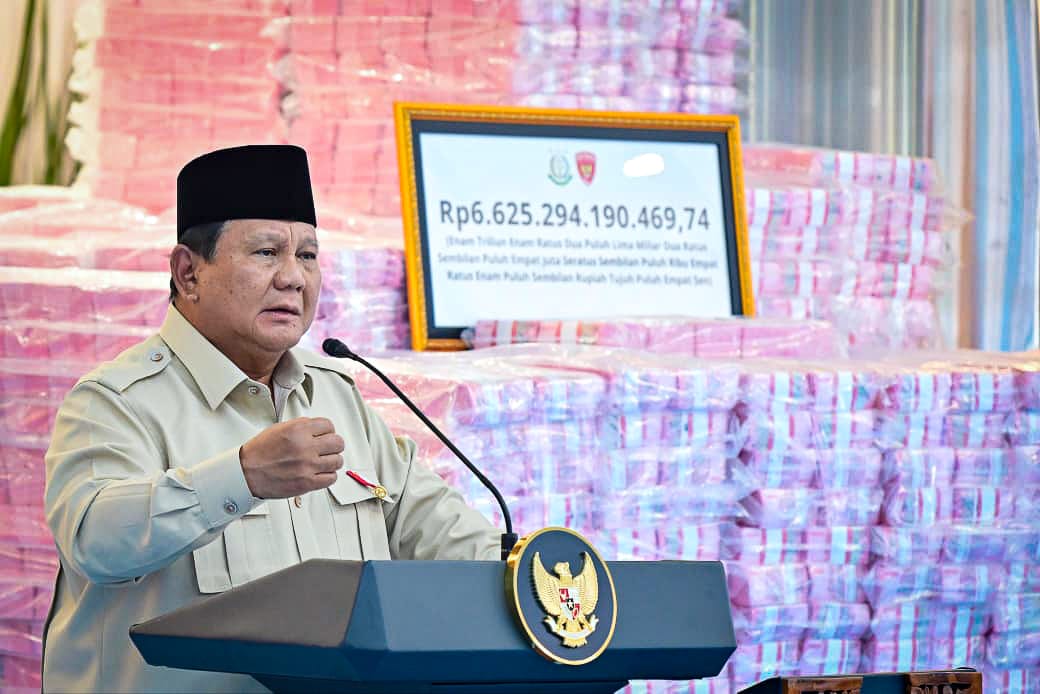
JAKARTA, GETNEWS — President Prabowo Subianto officially oversaw the recovery of over Rp6.6 trillion ($425 million USD) in state financial losses and the reclamation of 4.08 million hectares of illegally occupied forest land. This landmark achievement, reported by the Forest Area Management Task Force (Satgas PKH) on Wednesday (24/12), marks a decisive escalation in Indonesia’s battle against decades of systemic corruption in the natural resources sector.
The “Tip of the Iceberg” in Resource Governance
In a high-level briefing at the Attorney General’s Office, President Prabowo emphasized that these figures represent only the “beginning” of a massive structural overhaul. “This is just the tip of the iceberg of our national losses. Such deviations have persisted for decades,” the President stated, signaling that further billion-dollar fines and asset seizures are imminent.
Corporate Accountability: CPO and Mining Sanctions
The task force’s Phase V operation successfully targeted major corporate entities, recovering trillions from high-profile corruption cases and administrative violations:
Structural Integrity: Land Redistribution
Beyond financial recovery, the state has reclaimed 4,081,560 hectares of forest area—an area larger than the size of Switzerland. These lands, previously held by 124 legal entities, are being strategically redistributed:
- Commercial Plantations (240k Ha): Handed over to the Ministry of Finance and state-owned entities like Danantara and Agrinas for centralized management.
- Conservation Zones (688k Ha): Returned to the Ministry of Forestry for ecological restoration.
Global Insights Analysis: A Shift in the Investment Landscape
This aggressive enforcement of Presidential Regulation No. 5 of 2025 is a clear signal of deconstruction within Indonesia’s traditional socio-economic-political framework. For global investors, the “no compromise” stance—specifically targeting palm oil and nickel conglomerates—indicates that Structural Integrity is now the primary mandate. Moving forward, the integration of central fiscal strategies with local dynamic management will be the new benchmark for doing business in Indonesia’s resource-rich economy.


