
The Sadranan ritual is a ritual tradition to cleanse the graves of ancestors and visit graves with a procession of prayers and a communal feast.
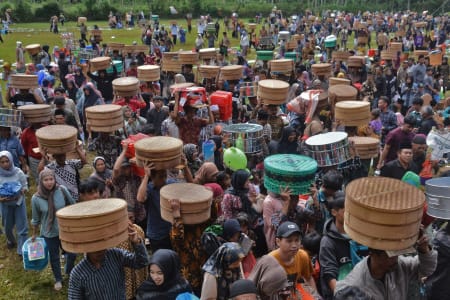
Thousands of residents from 15 villages in the Cepogo Sub-district, Boyolali Regency, Central Java Province, gathered in the Cepogo Square on Sunday morning, Feb. 9. Most of them wore traditional Javanese clothing and carried tenongan (round or flat tube-shaped woven bamboo food container) filled with various culinary delights. Residents of Mt. Merapi’s slopes filled the field to participate in the opening of the Grebeg Sadranan. This event was attended by residents of Cepogo and people from outside the region, such as Kartasura, Solo, and even Yogyakarta.
The event marked the beginning of the Sadranan or Nyadran, a tradition passed down through generations by the local community leading up to the holy month of Ramadan or Ruwah in the Javanese calendar. It is usually held in rotation in each village or hamlet, starting from the 10th day of Ruwah.
Therefore, the Association of Village Heads and the Cepogo Sub-district Government organized the Grebeg Sadranan. It began with a procession by all participants, representing residents from 15 villages in the Cepogo Sub-district, starting from the village head’s house in Mliwis to Pancasila Square. In addition to the tenong carried by the residents, there were nine gunungan (cone-shaped bamboo frames stacked with agricultural produce and traditional snacks). This gunungan were stacked with traditional Sadranan delicacies, namely apem (traditional snack made from rice flour, coconut, sugar, yeast, and tapai), sagon (traditional snack made from a mixture of grated coconut and sticky rice flour), jenang (traditional snack made from sticky rice flour, coconut milk, sugar, and added sliced-fruit), jadah (traditional snack made from steamed or fried sticky rice, served with grated coconut and salt), and others. Some villagers also carried gunungan stacked with agricultural produce and other traditional snacks.
The procession also included villagers carrying tumpeng (cone-shaped rice dish) with a full range of side dishes and ingkung ayam (whole roasted chicken). Upon reaching the square, many gunungans, dozens of tumpengs, and hundreds of tenongs were arranged in lines. Thousands of residents were there to seek blessings from the Grebeg Sadranan ritual.
The tenongs were divided into two groups, namely the West and the East. The western group consisted of offerings from residents of Wonodoyo, Jombong, Gedangan, Sukabumi, Genting, Cepogo, Kembangkuning, and Gubug Villages. The eastern group was from Sumbung, Paras, Mliwis, Jelok, Bakulan, Candigatak, and Cabeankunti Villages.
The core of the Sadranan event is prayer and reciting the Sadranan schedule for the 15 villages. It is hoped to become an annual festival consisting of a tenongan feast, a gunungan of agricultural produce and traditional food, and, most importantly, collective prayers so Cepogo will always be a prosperous, just, and thriving region.
“This is a manifestation of our gratitude to Allah SWT for bestowing countless blessings upon us,” said Mawardi, the Head of the Organizing Committee.
The Sadranan tradition in Cepogo Sub-district, Boyolali, was held until Feb. 21, 2025. Following the opening ceremony, the 14 villages in Cepogo Sub-district continued the Sadranan tradition according to the schedule set for each village.
Origins of Sadranan
It is said that this tradition has been practiced since the 15th century. The Sadranan tradition originated when Sunan Kalijaga and his followers spread the Islamic faith. In this area, before the arrival of Islam, residents had already held rituals where they gathered to pray for their ancestors.
The Sadranan ritual is a tradition to cleanse the graves of ancestors and visit graves with a procession of prayers and a communal feast. It is held annually in the middle of the Ruwah month or shortly before Ramadan. This procession is often called Nyadran or Sadranan, a tradition that has been preserved and continues to this day.
For the residents of Cepogo Sub-district, this tradition is similar to returning home for Eid al-Fitr. People from outside the region make time to return to their hometown in Cepogo during the Sadranan tradition. This tradition begins in the morning with a pilgrimage carrying tenong. After praying, they have an open house, and everyone is welcome to visit and enjoy the local dishes.
In addition to strengthening kinship ties between siblings, relatives, and other communities, the Sadranan tradition also maintains spiritual traditions for the safety and prosperity of the Cepogo community. The Regional Secretary (Sekda) of Boyolali Regency, Wiwis Trisiwi Handayani, appreciated the holding of this grebeg sadranan.
“The Boyolali Regency Government appreciates the holding of this grebeg sadranan. This activity is purely a mutual cooperative participation of the community from 15 villages in Cepogo. The district government did not give a single rupiah. The public’s enthusiasm is extraordinary. We express our gratitude and appreciation to the Cepogo community. We will make this an annual program,” said Wiwis.
Photo: Villagers carry tenong (round or flat tube-shaped woven bamboo food container) during the Nyadran Tenong Kembangsari ritual in Kembangsari Village, Kandangan, Temanggung, Central Java, Friday, Jan. 1. ANTARA FOTO/ Anis Efizudin.
indonesia.go.id