
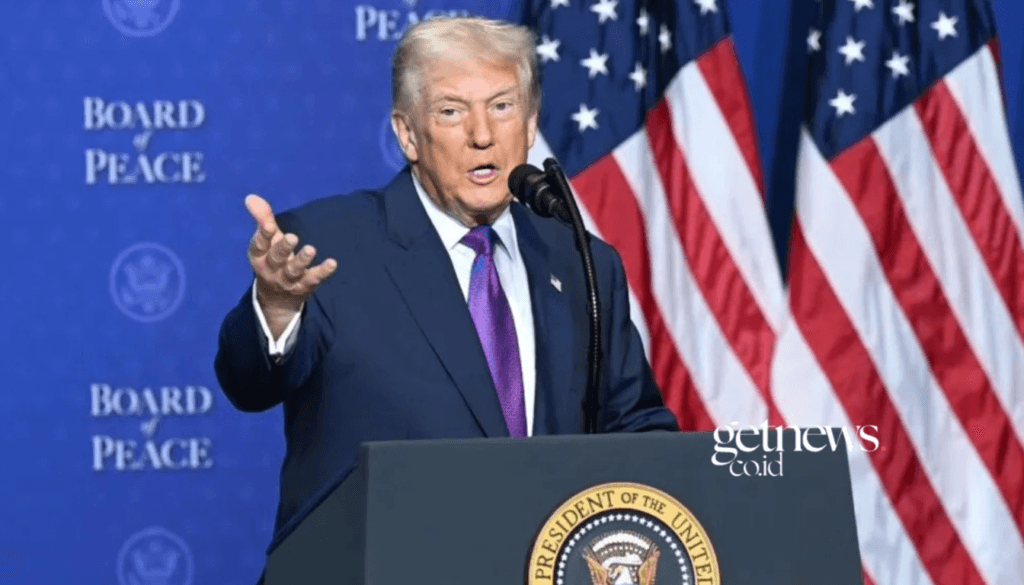
WASHINGTON – In a characteristically unorthodox maneuver that has sent shockwaves through the corridors of traditional diplomacy, Donald J. Trump took to Truth Social to announce a potential detente in the long-standing hostilities between the United States and the Islamic Republic of Iran.
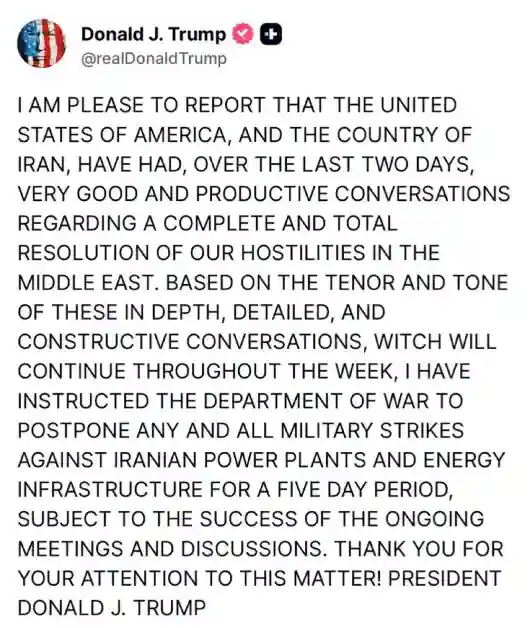
Claiming “very good and productive conversations” over the last 48 hours, the President has purportedly instructed what he termed the “Department of War” to implement a five-day moratorium on military strikes targeting Iranian power plants and energy infrastructure. The announcement suggests a high-stakes pivot toward “The Art of the Deal” on a global scale, where the currency of negotiation is the literal survival of a sovereign nation’s power grid.
The Grammar of Escalation and Ease
While the President’s post was marred by a curious typo—“Witch will continue”—the underlying message is anything but whimsical. This is a classic Trumpian overture: the carrot is the temporary cessation of a “complete and total” kinetic campaign, while the stick remains firmly gripped in the hand of the Pentagon.
By targeting energy infrastructure as the focal point of the moratorium, the White House has identified Tehran’s most vulnerable Achilles’ heel. For the Iranian leadership, the five-day window represents a brief respite from the looming threat of a darkened nation, but it also serves as a countdown. In the Trumpian lexicon, “constructive conversations” are rarely about mutual understanding; they are about terms of surrender.
| Analytical Component | Investigative Detail | Risk Assessment |
|---|---|---|
| Diplomatic Channel | Direct-to-Public Digital Decree (Truth Social) | UNCONVENTIONAL |
| Strategic Moratorium | 5-Day Freeze on Critical Energy Strikes | CRITICAL DELAY |
| Narrative Validity | Transactional Realpolitik (Maximum Pressure) | HIGH VOLATILITY |
Analysis: GetNews Global Intelligence Unit – 2026.
Maximum Pressure, Minimum Protocol
The bypass of traditional State Department channels in favor of a social media declaration reflects a broader shift in 21st-century statecraft. This is diplomacy reduced to its most transactional form. If Tehran can offer a “total resolution” that satisfies the President’s appetite for a definitive victory, the strikes may be permanently shelved. If not, the “Department of War” will find its targets once again in the crosshairs by week’s end.
The global markets have reacted with tentative optimism, yet the volatility of such a “deal” cannot be overstated. A peace built on a five-day timer is not a treaty; it is a stay of execution.
Conclusion: A New Order or Just More Chaos?
As the clock ticks on the five-day period, the world watches to see if this unconventional gambit will yield the stability the Middle East so desperately lacks, or if it is merely a tactical pause before a far more devastating storm. For now, the “Art of the Deal” has moved from the boardroom to the brink of war, and the stakes have never been higher.