

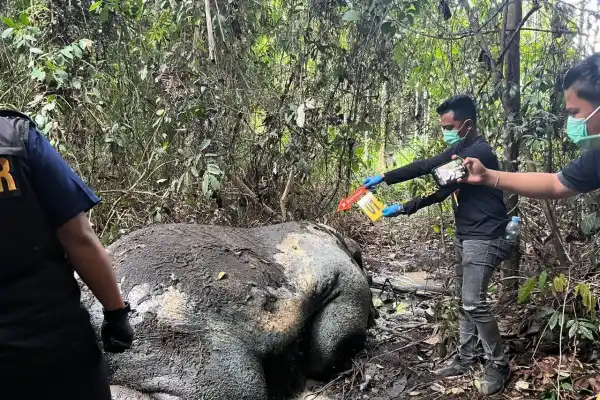
PELALAWAN — In the legal geography of Indonesia, the Sumatran elephant (Elephas maximus sumatranus) is a “protected” resident. In the economic geography, however, it is an inconvenient squatter. The discovery of a decapitated bull elephant on Friday, February 6th, within the concession of PT Riau Andalan Pulp and Paper (RAPP)—a subsidiary of the paper giant Royal Golden Eagle—offers a grim autopsy of Indonesia’s “Green Growth” promises.
The bull was found in a haunting, seated position, its head severed and its tusks vanished. This was no opportunistic kill by a local farmer; it was a surgical strike by a professional poaching syndicate. That such an execution could occur within the monitored boundaries of a global pulp leader raises a question that haunts the boardroom as much as the bush: How can a billion-dollar security apparatus fail to notice a chainsaw in the silence of the forest?
The Concession Paradox
For the industrial giants of Riau, elephants are a PR nightmare and an operational hazard. As natural forests are converted into the monotonous grids of acacia and eucalyptus, elephant corridors are pulverized into fragments. The pachyderms do not change their routes; they simply become more visible, more trapped, and infinitely more vulnerable.
When a bull elephant enters a concession, it is effectively entering a private jurisdiction. While companies tout their “Zero Deforestation” and “Coexistence” policies in glossy sustainability reports, the reality on the ground is often one of passive negligence. If a poaching team can infiltrate, execute, and de-tusk a multi-ton mammal within a managed sector, the “security” of that concession is a fiction.
Strategic Audit: The Failure of Corporate Stewardship
The Pelalawan incident confirms that “Conservation Zones” within industrial concessions are often nothing more than unmonitored dead zones.
The Verdict: Beyond “Thoughts and Prayers”
For the Ministry of Environment and Forestry (KLHK), the time for mere necropsies is over. If Indonesia is to be taken seriously as a global leader in biodiversity, it must apply the principle of strict liability. If a protected species dies in a concession, the permit holder should be held legally and financially responsible for the breach.
Without radical intervention in the ivory supply chain and a sharp upgrade in corporate accountability, the Sumatran elephant is destined to become a ghost in the acacia—a tragic externality of a paper industry that can track every log but refuses to watch over the lives that live between them.
Verified Source: ANTARANEWS.COM