

ACCORDING TO the fiscal bulletin of the Ministry of Supreme Intelligence—an Orwellian institution tasked with revising the past and controlling the future—the penetration of digital education in the capital has reached an absolute 100%. In the Central Sector, the children of the ruling elite wail in protest because their digital tablets do not match the seasonal autumn color palette. Shares of educational hardware providers surged at Friday’s closing bell. In the logic of the State, the abundance of touchscreens is a valid metric; empirical proof that prosperity has permeated the very pores of the nation.
However, as with all utopian programs, there is always a glitch—an irritating data anomaly on the fringes that ruins the statistical curve. This time, the anomaly exploded in Sektor Ngada.
In this world of doublethink, your existence is measured by an Identity Barcode. If your residential postal code is not aligned with the database of the bureaucratic machine, you are essentially a ghost. And Yohanes, a ten-year-old boy in Ngada, was a starving ghost possessed by a singular, subversive desire: he desperately wanted to learn.
Yohanes had been fatherless since the womb. His mother worked irregularly as a farm laborer in another sector, forcing him to live with his 80-year-old grandmother. Day by day, their stomachs were filled only with third-class carbohydrates—boiled yams and bananas from the garden.
The State, through its benevolent face on television screens, actually possesses a Smart Subsidy Program. Unfortunately, bureaucracy does not recognize empathy; it only recognizes numbers. The mother’s barcode was still registered in Sektor Nagekeo. For the scanning machines, this was a fatal violation. You cannot liquidate a scholarship fund if your code is incorrect, regardless of whether your ribs can be counted through your skin.
In the metropolis, “school needs” mean subscriptions to premium design software. For Yohanes, his needs were primal, analog, and cost less than ten thousand rupiahs: a single pen and a blank notebook. But for the lower working class, managing a cross-sector bureaucratic revision requires transportation costs equivalent to a month’s worth of food.
Thus, little Yohanes repeatedly visited the automated disbursement terminal at the village hall, only to be greeted by the polite but lethal mechanical voice of a woman: “Access Denied. Please resolve your residential administration. Thank you for loving the State.”
At this point, the bureaucratic machine successfully executed its victim without firing a single bullet.
To a ten-year-old who understood nothing of fiscal efficiency, the algorithm’s rejection was a death sentence. He felt himself to be an error weighing down the system and his mother. And so, on a silent day when no one was around, Yohanes decided to perform a “self-efficiency” measure. He eliminated himself from the long queue of poverty with a length of rope beneath a clove tree.
When the Peacekeepers (State security) arrived at the scene, they did not mourn the small body. In this republic, death due to extreme poverty is a mundane occurrence, simply revised in monthly reports as a “Failure of Oxygen Adaptation.” However, there was one thing at the crime scene that turned the squad commander pale and prompted an immediate declaration of a National Emergency.
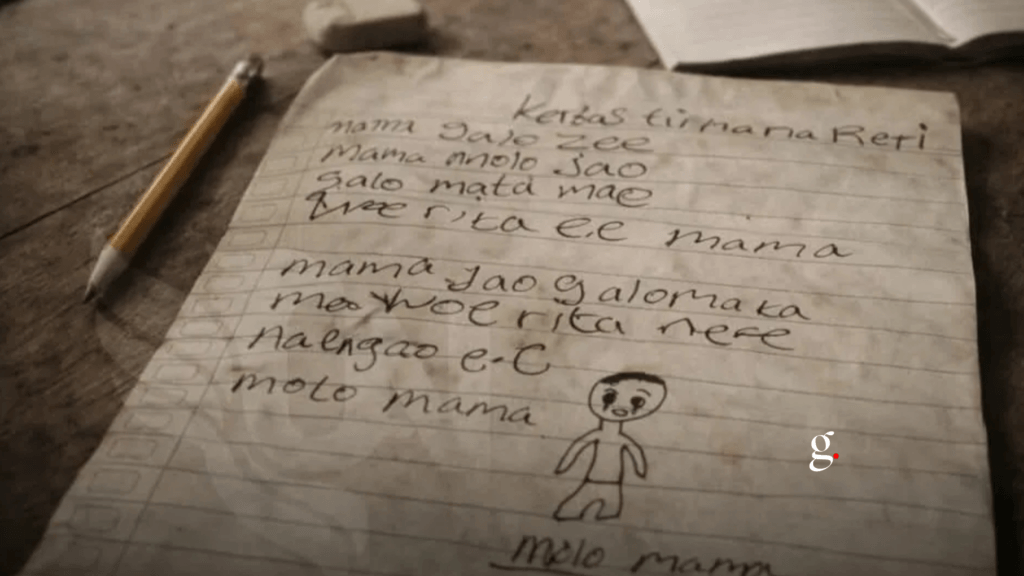
Beneath Yohanes’ feet lay a suicide note. Handwritten.
In an era where every narrative must be typed through screens monitored by the State, a pen is an illegal artifact. A pen leaves a physical ink trail that cannot be backspaced, cannot be hacked, and cannot be automatically deleted by a censorship algorithm.
The letter was written in the Bajawa dialect—a local tongue not included in the government’s official Newspeak dictionary. Its contents were soul-crushing: a farewell to his mother, an apology for never being able to buy a pen and a book, and a message that she no longer needed to bother with his complicated subsidy administration.
The letter was physical evidence of the State’s rot—a raw narrative of hunger and despair that no bureaucrat could edit.
“Secure this artifact!” the Commander shouted, pointing at a three-thousand-rupiah plastic pen on the floor as if it were a biological warhead. “And burn this paper immediately before the cameras catch it!”
The following morning, The Economist might release a cold, analytical, and detached editorial: “The Ngada Incident: Central Government to Tighten Distribution of Analog Writing Tools Deemed Disruptive to Psychological Stability. Markets responded positively; educational tablet vendor stocks remain stable in the green. Reports of a minor’s death have been confirmed as cognitive dissonance, now fully under control.”
The world keeps turning. The bureaucratic algorithm hums again, cataloging the living and purging the dead. No one writes that Yohanes was not killed by a rope, but by an administrative form. To the State, the life of a poor child from the periphery is cheap, very cheap. But a pen used to write an honest suffering? That is an item far too expensive for a regime whose foundation is built upon digital lies.
Editorial Credit: Translated and adapted by the Executive Editor (Global) for GetNews Anomalous Lore.