
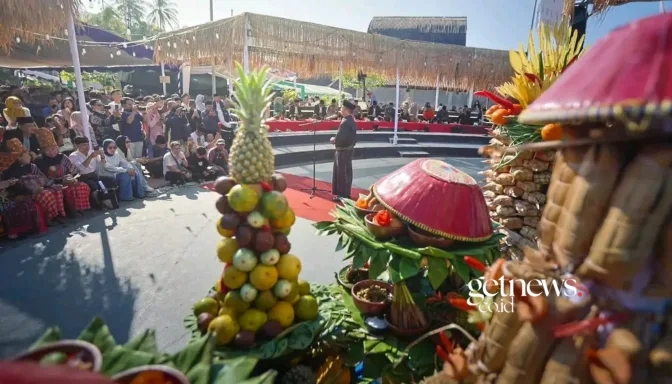
SENGGIGI, LOMBOK — On the sun-drenched shores of West Lombok, the air carries a distinct olfactory signature: the earthy scent of woven palm fronds mingling with the briny tang of the Indian Ocean. This is Lebaran Topat 2026, a uniquely Sasak phenomenon that occurs exactly eight days after Eid al-Fitr. While much of the Islamic world has returned to the grind of commerce, the island of Lombok is doubling down on a tradition that deftly weaves spiritual austerity with a high-octane cultural carnival.
Centred around the hallowed Makam Batulayar and the Senggigi Amphitheatre on Saturday, March 28, the festival has evolved from a quiet communal prayer into a sophisticated display of soft power. Thousands of pilgrims, clad in their finest traditional brocades, descended upon the coast, carrying dulang (ceremonial trays) of diamond-shaped rice cakes—the eponymous ketupat.
The Philosophy of the Four Corners
The Governor of West Nusa Tenggara, Lalu Muhamad Iqbal, alongside West Lombok’s leadership, was on hand to lend political weight to the proceedings. For the Governor, the ketupat is not merely a culinary staple but a geometric metaphor for the human condition. He articulated the four-fold philosophy of the craft: Lebaran (the end of the fast), Luberan (an overflow of charity), Leburan (the dissolving of sins), and Labur (the restoration of purity).
”This is not just a vestige of the past,” the Governor remarked, “but a spiritual reflex that recalibrates our relationship with the Divine and the community.” It is an astute observation; in an era of digital fragmentation, Lebaran Topat serves as a crucial social glue, reinforcing a collective Sasak identity that is increasingly marketable to the global “experience economy.”
Tradition Meets the Tourist Gaze
Historically, Lebaran Topat was a somber ritual of ziarah (grave visitation) and family picnics. However, the 2026 iteration demonstrates a more muscular approach to cultural tourism. Local resorts and international hotels in the Senggigi corridor have integrated into the parade, blending creative floats with traditional Gendang Beleq percussion.
West Lombok Regent Lalu Ahmad Zaini emphasized that while the festival remains rooted in the pulse of ancestral heritage, its role as a tourism magnet is undeniable. By transforming a religious obligation into a vibrant public spectacle, Lombok is successfully positioning its cultural assets as a primary draw, ensuring that the “Island of a Thousand Mosques” remains as much a destination for the soul as it is for the sun-seeker.
Editorial Credit: Translated and adapted by the Executive Editor (Global) for GetNews Indonesia Insights.