

The Protocol of Holding Someone Hostage Without Handcuffs
When power no longer needs to issue threats because obedience has already been cultivated as a sense of personal obligation.
In the southern wing of the State Building, no one ever raised their voice or slammed a fist against the table.
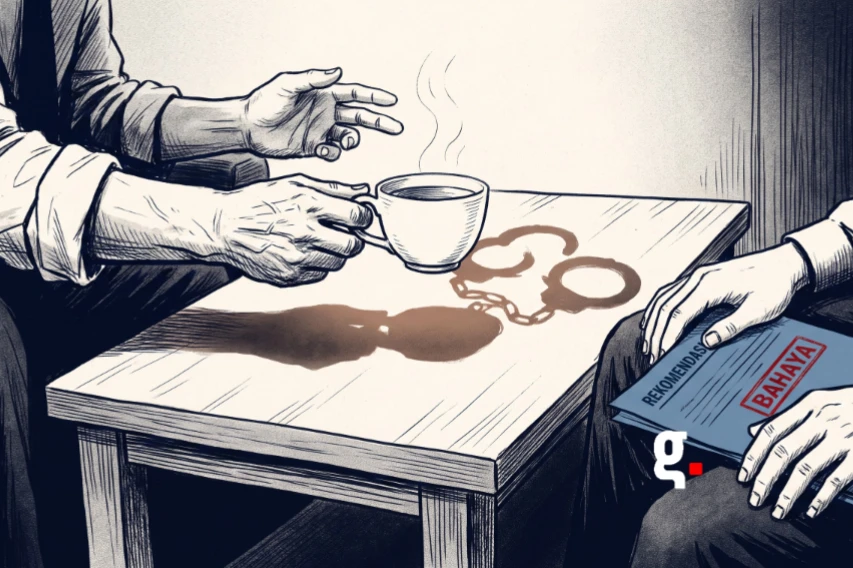
The room was too quiet to resemble an interrogation chamber, yet too carefully arranged to be mistaken for an ordinary reception room. There were two teakwood chairs upholstered in traditional woven fabric, a low table, and the faint fragrance of jasmine tea, invariably brewed five minutes before a guest was invited inside.
There were no conspicuous cameras. No excessive display of institutional insignia. Even the wall clock seemed to move without making a sound.
In a room like this, there was no need to frighten anyone. It was enough to make them feel important.
Raka sat upright, his back stiff. On his lap rested a blue folder containing a draft spatial-planning recommendation he had refused to approve for the past three months. The document was problematic. Environmental setback requirements had been violated, the impact assessment remained unconvincing, and several technical provisions had yet to be satisfied.
As the official responsible for the recommendation, Raka knew exactly what he was supposed to do: reject it.
That morning, however, he had been summoned without warning. Not through the usual chain of official correspondence, nor through his immediate superior. Instead, a phone call from an unfamiliar number delivered an invitation with almost impeccable courtesy.
“Mr. Raka, the President is expecting you in the South Room.”
No further explanation was offered.
The carved wooden door opened quietly. The country’s highest-ranking leader entered without an entourage at his side. His white shirt sleeves were rolled up to his forearms. His smile was faint, almost resembling that of an uncle returning from the morning market.
“Have you been waiting long, Mr. Raka?”
He took the seat opposite him and offered a white porcelain cup.
“Have some tea. It will get cold.”
Raka hesitated.
He had prepared ten pages of technical arguments concerning environmental impact assessments, spatial-planning violations, and the risk of legal action. Everything had been arranged in meticulous order, complete with references to the relevant regulations.
But not a single page had prepared him for the possibility of facing a leader who suddenly treated him like a member of his own family.
“How is your mother in Solo?”
Raka looked up.
“I heard she was recently hospitalized because her blood sugar went up. Is she doing better?”
For a moment, he forgot what he was supposed to say.
Information about his mother’s health had never appeared in his personnel records. He had never considered it necessary to discuss family matters with anyone at the office.
“Thankfully, she’s recovering, Sir. She got better last week.”
“That’s good to hear. If she ever needs a specialist in Jakarta, just let my aide outside know.”
The President leaned forward, resting both elbows on his knees.
“Now, Mr. Raka, I’m a man who understands the realities on the ground. I know you’re intelligent, principled, and not the sort of person who gets involved in questionable business. That’s why I asked to see you personally. I didn’t go through the minister or the director-general. I trust you directly.”
The words were simple. They sounded almost like a compliment.
Yet something inside Raka began to shift.
For twenty years in public service, he had understood that decisions were supposed to follow hierarchy, procedure, and institutional authority. But that morning, he was being offered something no organizational structure had ever given him: personal recognition from the most powerful man in the country.
He felt chosen.
Not merely as an official who understood regulations, but as someone who occupied a special place in the President’s confidence.
Perhaps this was one of the more effective ways of transforming a relationship of power: making someone feel that they were not being instructed, but trusted.
The President then touched the blue folder on Raka’s lap.
“That project on the eastern coast.”
His voice dropped slightly.
“Some of the regulations are a little tight, I understand. I know you have concerns. But the people there need investment, and they need it quickly. If we keep looking at everything through the rigid lens of old regulations, when will we ever move forward?”
He paused.
“I’ll leave this matter with you, Mr. Raka. I’m sure you can find a way through it. Can you?”
There was no written instruction.
No threat of reassignment.
No explicit order to break the law.
Only a request, wrapped in trust, personal concern, and a faint expectation.
And that was precisely where the problem began.
A threat makes a person aware that they are being coerced. A compliment can make them unaware that they are being steered.
Raka lowered his eyes. They settled on the blue folder.
He knew the documents did not meet the requirements. He also knew that approving them would compromise something he had spent years protecting: the boundary between his professional responsibilities and someone else’s interests.
But one thing now weighed more heavily than all the regulations he had memorized.
He did not want to disappoint someone who had just described him as a trusted man.
“Understood, Sir. I’ll review the regulatory provisions and see what can be done today.”
The President smiled.
He patted the back of Raka’s hand twice before standing.
“Thank you, Mr. Raka. Finish your tea.”
The meeting had lasted less than half an hour.
Not a single raised voice had been heard.
As Raka stepped out of the South Room, his stride felt strangely light and heavy at the same time.
In the marble corridor, he passed a director-general from another ministry, who was carefully arranging the documents in his folder. In a corner seat, a ministerial candidate adjusted his tie while occasionally glancing toward the same carved wooden door.
They had arrived separately.
They had been summoned through the same door.
They had been served the same tea.
And perhaps they had also been asked about the most private matters in their respective lives.
No one knew exactly what had been discussed inside. There would be no meeting minutes to sign, no formal resolution to serve as evidence that an instruction had been issued.
Yet each person left carrying something.
Some carried a sense of pride.
Others carried a sense of indebtedness.
And some, perhaps, carried decisions they had never imagined themselves making.
That evening, Raka sat alone in his office.
The blue folder lay open on his desk. He reread his objections, examined the spatial-planning maps, and reviewed the provisions that had previously formed the basis of his refusal.
This time, he was no longer looking for reasons to reject the proposal.
He was looking for loopholes through which it could be approved.
Several sentences in the recommendation were revised. Some technical objections were moved into a category of issues that could be addressed at a later stage. Requirements that had not been met were given room for interpretation.
Not every regulation was openly violated.
Some were simply stripped of their force.
Raka signed the approval document.
His hand was not trembling because he feared losing his position. Nor did he feel that he was doing something entirely against his own will.
He simply felt that he was returning a favor.
And perhaps that was the most troubling part of the entire affair.
When the ink had dried, Raka leaned back in his chair. His eyes fell on the coffee cup at the corner of his desk.
Without thinking, he lifted it, unconsciously repeating the gesture the President had made earlier that afternoon.
Then a chill ran down the back of his neck.
He thought of his mother.
He remembered the words about trust.
He remembered how the ten pages of technical arguments he had carefully prepared had suddenly lost their force after a simple question about the health of someone he loved.
For the first time, he asked himself: when had concern become a means of controlling someone’s decisions?
In politics, we often imagine power operating through threats, dismissals, intimidation, or direct orders.
Yet there is a far subtler form of control: making someone feel personally connected to power until obedience no longer resembles an obligation, but rather an act of loyalty.
Social psychology offers a useful concept for understanding this mechanism: reciprocity, the human tendency to return favors or kindness received from others.
When such kindness comes from someone wielding extraordinary power, the resulting sense of indebtedness can become disproportionate. The recipient no longer sees themselves as dealing with a public official exercising institutional authority, but with someone who has granted them a rare and personal privilege.
This is where the distinction between genuine kindness and manipulation becomes essential.
Concern, in itself, is not manipulation. Asking about someone’s family is not misconduct. Showing personal consideration toward a subordinate is not inherently an abuse of authority.
The anomaly emerges when personal closeness is used to displace professional judgment, undermine independence, or make someone feel compelled to repay kindness through decisions that should be governed by law.
More troubling still, when this pattern is repeated, it can produce a bureaucracy that no longer operates primarily on the basis of rules, but on the basis of personal proximity to power.
On paper, everyone still holds an official position.
In practice, some people have access.
And in a system overly dependent on the will of its leader, access can become a form of power in its own right.
No handcuffs are necessary to make someone surrender their freedom to decide. It is enough to make them believe they are being honored.
For a person who feels indebted, saying no can sometimes be far more difficult than resisting an explicit threat.
That night, Raka finally understood something that had never been taught in his years of civil-service training.
In this republic, the strongest chains may never have been forged in some underground prison. They may simply be brewed in a cup of warm tea, served with a smile, and willingly swallowed by someone who believes he is being shown respect.
And perhaps the greatest irony is that, when the trap finally tightens around his neck, he may still find himself thanking the person who placed it there.
Editor: Lilisatya Wati / Photo: AI Gemini