

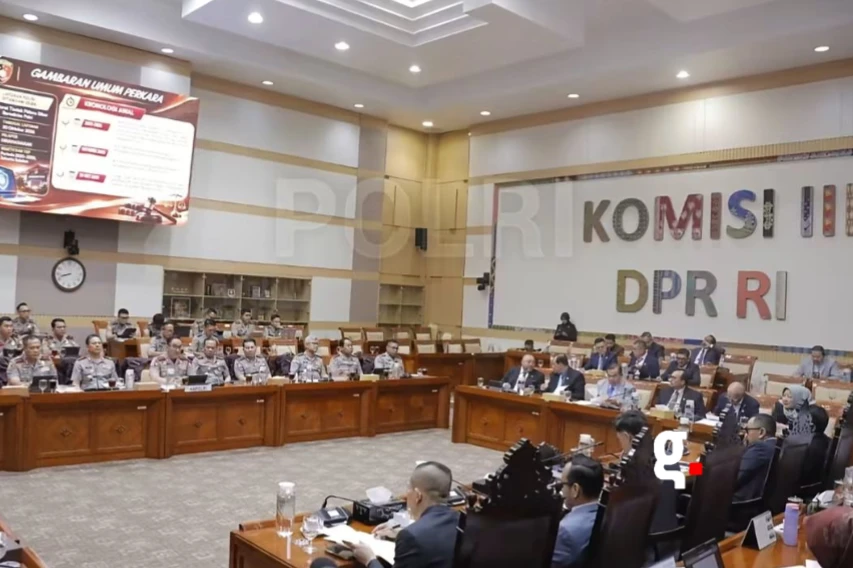
Judicial Rebuke for Fast-Track Legislation: Constitutional Court Orders Revision of 2026 Police Law Within One Year

Ruling No. 251/PUU-XXIV/2026 exposes the insertion of new provisions contradicting an earlier Constitutional Court decision, setting a strict one-year deadline for Parliament and the Government before the statute automatically lapses.
Indonesia’s Constitutional Court (MK) has once again pulled the emergency brake on legislative shortcuts that bypass procedural guardrails and prior judicial mandates. During a formal judicial review hearing for Case No. 251/PUU-XXIV/2026 in Jakarta on Monday (November 23, 2026), the Court ordered lawmakers—the House of Representatives (DPR RI) and the Government—to revise Law No. 5 of 2026 on the Indonesian National Police (UU Polri) within a maximum period of one year from the pronouncement of the verdict.
Under the ruling, the Court declared Law No. 5 of 2026 conditionally constitutional, allowing the statute to remain enforceable while revisions are undertaken. However, should lawmakers fail to complete the required amendments within the 12-month window, the law will automatically become unconstitutional and lose all legally binding force.
At the core of the rebuke is the legal opinion delivered by Constitutional Justice Enny Nurbaningsih, who found that lawmakers used Constitutional Court Ruling No. 114/PUU-XXIII/2025 as an entry point to fast-track the bill, yet inserted substantive new provisions that diametrically contradict both the letter and spirit of that earlier decision
| Judicial Dimension | Findings & Court Reasoning | Legislative & Institutional Impact |
|---|---|---|
| Statutory Status | Police Law No. 5 of 2026 declared conditionally constitutional under Ruling No. 251/PUU-XXIV/2026 (November 23, 2026). | Prevents an immediate operational legal vacuum for law enforcement during the revision period through November 2027. |
| Procedural Defect | Insertion of new material diametrically opposed to the spirit of Ruling No. 114/PUU-XXIII/2025, which had been cited to justify accelerated deliberation. | Curbs lawmakers’ latitude to exploit open cumulative lists (daftar kumulatif terbuka) for unrelated statutory expansions. |
| Deadline Sanction | Maximum revision window of 1 year from the date the ruling was read. | Failure to revise on time automatically renders Law No. 5 of 2026 unconstitutional and legally void. |
Three Critical Takeaways: Reining in Legislative Shortcuts and Security Governance
1. Halting the Practice of “Piggybacking” on Court Rulings
In Indonesian legislative practice, lawmakers have frequently relied on the open cumulative list mechanism—triggered by Constitutional Court rulings—as a shortcut to expedite bills without passing through the annual National Legislation Program (Prolegnas) priority cycle. Justice Enny Nurbaningsih’s reasoning squarely closes that loophole: legislative follow-ups to a prior verdict (Case No. 114/PUU-XXIII/2025) are valid only insofar as they fulfill the substantive mandate of that ruling, not as a vehicle to smuggle in sweeping new provisions that contradict the original judgment.
2. Conditional Constitutionality: Preserving Operational Stability
The Court’s choice of a one-year conditionally constitutional formula—rather than invalidating Law No. 5 of 2026 immediately—reflects deliberate judicial prudence. As the primary institution tasked with maintaining public order, domestic security, and daily criminal law enforcement, an abrupt statutory void could disrupt administrative authority and field operations. By granting a 12-month grace period, the bench compels Parliament and the executive to rectify the law without destabilizing national security.
3. A Tight Legislative Race Amid Coalition Realignment
The one-year deadline expiring in November 2027 puts the DPR and the Government on a strict legislative clock. Amid a crowded national political agenda—dominated by coalition negotiations and executive transition priorities—lawmakers have little room to stall deliberations. Should the amendment process become bogged down by inter-party bargaining or fall short of meaningful public participation standards, the automatic invalidation of Law No. 5 of 2026 will stand as a stark formal rebuke to both branches.
Policy Outlook and Implications
Constitutional Court Ruling No. 251/PUU-XXIV/2026 underscores a clear constitutional boundary: legislative speed in Senayan cannot come at the expense of procedural integrity and adherence to judicial precedent.
Over the next twelve months, Parliament and the Government will be expected to reopen transparent public consultations, strip out extraneous clauses that diverge from Ruling No. 114/PUU-XXIII/2025, and ensure that institutional reforms within the National Police remain firmly anchored in democratic accountability and the rule of law.
DATA SOURCES & NEWS REFERENCES:
- Primary Media Report: Tribunnews.com — Breaking News: Constitutional Court Orders Latest Police Law Revised Again, Grants 1-Year Deadline (November 23, 2026)
- Judicial Documents: Constitutional Court of the Republic of Indonesia Ruling No. 251/PUU-XXIV/2026 (Formal Judicial Review of Law No. 5 of 2026 on the Indonesian National Police) & Constitutional Court Ruling No. 114/PUU-XXIII/2025.
Foto: Divisi Humas Polri