
THE GEOPOLITICAL RIDDLE behind President Prabowo Subianto’s sudden directive to introduce French language instruction across Indonesian schools has finally been solved. According to an investigative report by Kompas.com, this radical overhaul of the national curriculum is the direct “souvenir” of the president’s recent bilateral visit to Paris. The mandate is sweeping, targeting all tiers of the national education ecosystem, from secondary schools up to higher education institutions.
However, for educators and parents already struggling with erratic shifts in school administration, the directive triggers a exhausting sense of déjà vu. Only a short while ago, the administration floated an expansion of Portuguese language training following a state visit to Lisbon. Before local teachers could even digest the vocabulary of the Iberian Peninsula, they were forced to realign their syllabi to match new instructions from the French capital, encapsulated by the pointed domestic headline: “Yesterday Portuguese, Now French: Schools Shoulder New Burdens to Follow Foreign Policy Direction”.
A Curriculum Driven by Flight Itineraries: When State Visits Dictate Student Backpacks
This phenomenon of a “destination-driven curriculum” gives significant weight to the sharp warnings issued by diplomatic heavyweights. Dino Patti Djalal, founder of the Foreign Policy Community of Indonesia (FPCI), recently revealed that President Prabowo has spent one out of every six days of his tenure traveling abroad—a global frequency he described as highly unconventional.
The systemic fallout of this high-intensity personal diplomacy is now directly squeezing the domestic education sector. Every time the president returns home bearing foreign red carpets and international accolades, the domestic schooling system is abruptly forced to pivot, aligning itself with whatever way the executive’s personal diplomatic winds are blowing.
As a result, Indonesian students are enduring a double bind. On one side, their backpacks grow heavier with new foreign language textbooks whose state procurement budgets remain structurally vulnerable to leaks. On the other side, they are expected to master French verb conjugations beneath leaky roofs and on dilapidated benches—a sobering legacy of the failed Chromebook digitalization campaigns of the previous ministerial era.
The “Sorry Yé” Manifesto Amidst Academic Backlash
This groundswell of academic resentment has, fortunately, been met with brilliant creative resistance within civil society through internet satire. The viral spread of a parodied version of the official French government logo—altered by netizens to read “Liberté, Émbegé, Sorry yé – RÉPUBLIQUE OQUEGAS” (as seen in file 1000322760.jpg))—is a clear sign that the public is growing fatigued by cosmetic policy updates.
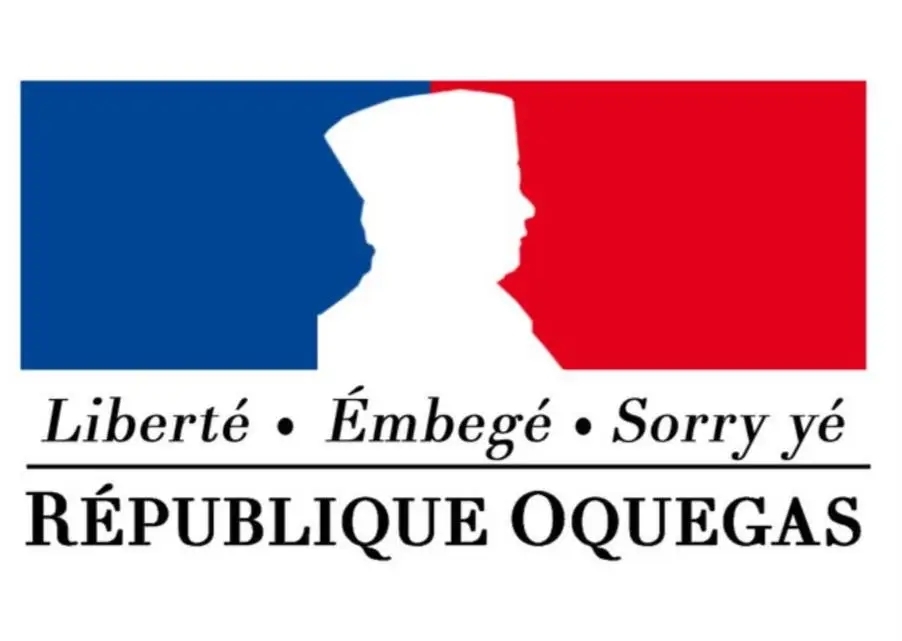
While teachers decry the absolute lack of infrastructural readiness and macroeconomists warn that the economy is facing a severe double bind due to a weakening Rupiah, the palace appears to favor a remarkably relaxed communications path.
The uproar over the shifting curriculum, the moral alarm raised by intellectuals in Yogyakarta, and the stinging critiques from the international press are all treated as noise that can be deflected with a single populist mantra: “Sorry yé, Oke Gas!” Policy marches forward, the 2027 draft budget remains highly expansionary, and the question of whether underfunded rural teachers can properly articulate French phonetics is left as a secondary concern.
Awaiting the Next Flight Departure
Ultimately, the public can only hope that President Prabowo’s next international flight itineraries do not lean too exotic. If the executive decides to embark on high-profile state visits to Athens, Reykjavik, or Nairobi in the coming months, the national education system must prepare itself to introduce ancient Greek script or Swahili into the next semester’s textbooks.
For now, teachers and university lecturers across the country must brace themselves to study European linguistics overnight. We can only watch from inside the “Ship of State” as it hurtles down the highway with compromised brakes, holding tightly to our children’s schoolbags. Bon courage to the working class holding onto their monthly installments—and above all, Oke Gas!