
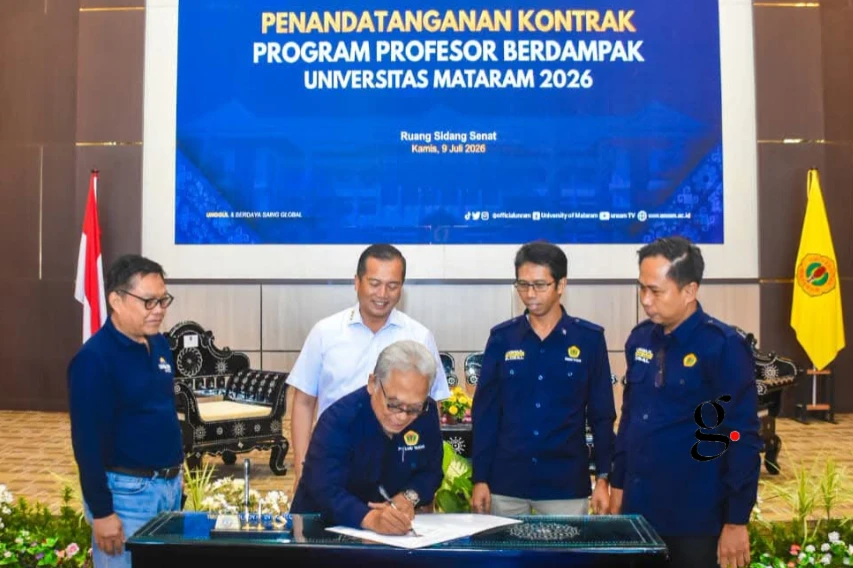
MATARAM — In an ambitious attempt to shake up rural development, the West Nusa Tenggara (NTB) provincial government is gambling on academic muscle to fix its most stubborn economic failure: rural poverty. On July 9, 2026, Governor Lalu Muhamad Iqbal and the Rector of the University of Mataram (Unram), Professor Sukardi, signed a strategic Memorandum of Understanding (MoU). The agreement hitches the province’s structural development blueprint, “Desa Berdaya” (Empowered Villages), to the university’s new deployment scheme, “Profesor Berdampak” (Impactful Professors).
The policy marks a distinct shift away from traditional, cash-heavy social safety nets toward a model of targeted technology transfer. By pushing high-level academics out of the lecture halls and into the field, the regional government is attempting to address the root causes of economic stagnation rather than simply subsidising its symptoms. For a province where rural communities frequently miss out on the wealth generated by tourism and infrastructure booms, the intervention aims to foster local industrial autonomy.
Deploying Applied Science
The operational mechanics of this three-year alliance are designed to ensure direct corporate-style accountability in rural development:
- The Academic Cohort: A total of 122 professors, organized into 22 specialized cross-disciplinary teams, will be dispatched directly to vulnerable sub-districts.
- Value-Chain Optimization: Rather than conducting abstract research, these experts are tasked with building localized micro-enterprises, refining supply chains, and introducing agricultural innovations.
- Mid-Term Horizon: The project is locked into a strict 3-year timeline, with subsequent phases designed to integrate junior faculty members and student-led rural internships (KKN) to maintain operational continuity.
“Combating extreme poverty requires more than just paper-based aid and social safety nets. Rural communities need hands-on mentorship and tangible innovation to achieve genuine economic independence.”
— Dr. H. Lalu Muhamad Iqbal, Governor
Strategic Audit: Academics vs. Welfare Injections
Can a group of tenured professors achieve what decades of state welfare subsidies could not? The analytical matrix below compares the structural efficacy of both frameworks:
| Policy Dimension | Conventional Welfare Transfers | The Pemprov-Unram Framework |
|---|---|---|
| Economic Stimulus Type | Short-term liquidity injections; consumer goods distribution | Commercialization of research; production tool innovation |
| Mentorship Delivery | Intermittent administrative oversight by local bureaucrats | Continuous, structured guidance by 122 senior professors |
| Fiscal Sustainability | Fosters systemic state budget dependency at village level | Builds capital autonomy via localized value-added gains |
The success of Governor Iqbal’s experiment will depend on how well academic theory survives the social realities of rural Lombok and Sumbawa. The biggest risk is bureaucratic inertia—the danger that this initiative devolves into a mere box-ticking exercise for university promotion credits. If these 122 professors can successfully translate their corporate and scientific insights into better yields and higher profit margins for rural farmers, NTB will have built a powerful, low-cost blueprint for regional development across eastern Indonesia. If they fail, the ivory tower will simply look a little more out of touch.