
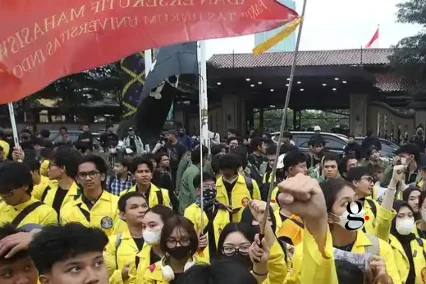
JAKARTA — The waves of intellectual street movements protesting recent macroeconomic fiscal tightening have reached a critical tipping point. Chairman of the Universitas Indonesia Student Executive Board (BEM UI), Yatalathof Mashum Imawan, confirmed that an estimated 3,000 university students packed the iconic Bundaran HI intersection in Menteng, Central Jakarta, on Friday, June 12, 2026, creating a massive focal point of civilian dissatisfaction in the heart of the capital.
The high-density rally in Jakarta was not an isolated event; it served as the culmination of a synchronized national wave of student-led protests erupting across multiple strategic regional hubs in Indonesia over the past 72 hours.
According to investigated field manifestos, the coordinated nationwide demonstrations were ignited by deep-seated resentment toward the government’s sudden energy tariff adjustments and the perceived misallocation of state project funding:
- Southeastern Sulawesi Flashpoint: On Wednesday night, June 10, 2026, student groups in Kendari took aggressive tactical measures by setting up blockades along primary economic transit routes and burning tires, paralyzing local logistics for hours.
- West Java Siege: Following the momentum, on Thursday, June 11, 2026, hundreds of students in Bandung swarmed and surrounded the West Java Regional Legislative Council (DPRD) building, demanding an immediate provincial intervention to block the national fuel price hike.
Accusations of Project-Doleouts Amidst Middle-Class Squeeze
In a fiery street brief delivered from atop the demonstration truck at Bundaran HI, the BEM UI leader launched sharp criticism against the executive branch. He accused the Merdeka Palace of being detached from the economic realities of the squeezed middle class, claiming the administration is excessively focused on image-polishing campaigns and distributing massive infrastructure contracts rather than addressing basic household survival metrics.
The timing of these protests is highly delicate, coinciding with the central bank’s recent aggressive hike of the BI-Rate to stabilize the fluctuating rupiah, which had hovered near the level of Rp18,066 per US dollar. The subsequent price adjustment of non-subsidized Pertamax fuel has triggered a domino effect on regional transport operational costs.
While Minister Bahlil Lahadalia and Coordinating Minister Airlangga Hartarto have repeatedly issued public guarantees locking subsidized fuel prices to protect low-income households, the student alliance claims that the broader inflationary pressure on logistics and basic food supplies remains a structural failure that cannot be solved by seremonial subsidies alone.
Implications for Regional Hubs and Public Security
The ripple effects of this prolonged national social unrest are being closely monitored across outer economic regions, including the province of West Nusa Tenggara (NTB) under Governor Dr. H. Lalu Muhamad Iqbal. Although regional security forces and the Korem 162/Wira Bhakti have successfully maintained public order across Lombok and Sumbawa through the proactive enforcement of the KDKMP food security zones, a prolonged transport strike or supply chain disruption in Java could severely threaten NTB’s tourism recovery at Mandalika.
Local travel agencies operating under the newly structured DPD ASITA NTB (2026–2031) have urged the central government to establish a swift, legally binding compromise with the student coalition. This step is deemed critical to prevent localized rallies from escalating into wider public order disruptions that could jeopardize international visitor confidence right before the highly anticipated global broadcast of the 2026 World Cup group stage matches next week.
INDONESIA INSIGHTS: STRATEGIC AUDIT OF NATIONAL STUDENT PROTEST TRAJECTORY, JUNE 2026
| Protest Hub / Leadership | Mobilization Volume & Chronological Milestones | Risk Management Output & Regional Security Implications |
|---|---|---|
| BEM UI Alliance (Chairman: Yatalathof Mashum Imawan) Key Demands: Fuel Price Reversal & Project Accountability. | • Jakarta (June 12): 3,000 students at Bundaran HI intersection. • Bandung (June 11): Siege of West Java DPRD Building. • Kendari (June 10): Route blockades and burning tires. | 1. Mitigating Civil Unrest Escalation: The massive turnout at Bundaran HI serves as a structural warning indicator of declining public confidence among the middle class, requiring the government to transparently publish its fiscal efficiency metrics for the MBG program to isolate further political exploitation. 2. Securing Outer-Island Logistics Hubs: Regional police commands, including the NTB Regional Police, are urged to step up security audits across strategic maritime ferry points (Lembar and Kayangan) to insulate local supply lines from echoing the blockades seen in Kendari. 3. Anti-Corruption Control Framework: To effectively defuse student grievances regarding “project doleouts,” the Ministry of State Secretariat must enforce strict digital transparency over infrastructure vendor bidding, aligning procurement with the anti-fraud principles of KPK SE No. 7 Year 2026. |
Socio-Political Audit: Getnews Socio-Political & Public Accountability Research Unit | Evaluation of Civil Movements, Macro Fiscal Risk Analysis, and Regional Security Assessment, June 2026.