
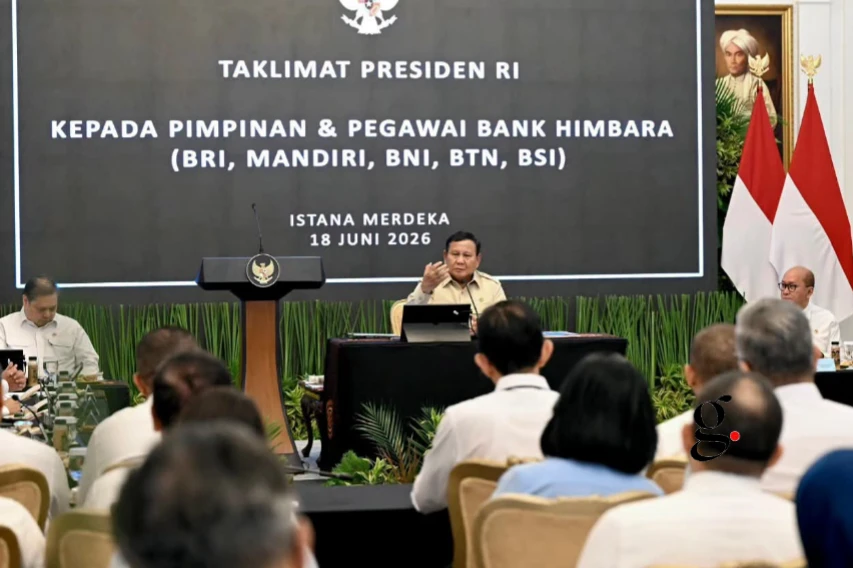
AMID A MOUNTING wave of domestic friction—ranging from street-level tax protests and tears in the Constitutional Court to ministers dodging student blockades via back exits—President Prabowo Subianto found temporary refuge in a far more predictable setting. Opting out of the Russia-ASEAN summit in Kazan, the President instead convened an assembly within the state rooms of the Merdeka Palace, surrounded by 100 of the nation’s top banking executives who hold the keys to the republic’s financial machinery.
The high-powered summit brought together the complete boards of directors and commissioners from the State-Owned Banks Association (Himbara), comprising BRI, BNI, Bank Mandiri, BTN, and BSI. This gathering marked the first time a sitting Indonesian president has assembled the entire upper echelon of state banking leadership in a single room.
In his briefing, Prabowo reminded the assembled executives that Himbara must look beyond mere margin-hunting and dividend yields. With a combined market capitalization of approximately Rp1,100 trillion—roughly 10 percent of the total value of all national enterprises—the association carries significant socio-economic weight. This figure presents an ironic parallel: the sum matches recent estimates by the think-tank CELIOS regarding the total cost of the administration’s extensive international travel over the past 18 months.
The President directed these state financial giants to aggressively expand credit access for Micro, Small, and Medium Enterprises (MSMEs) and to align their lending portfolios with government priority programs. In the current economic climate, marked by tightening regional liquidity and fiscal strain from aggressive funding shifts, state banks appear to be positioned as a crucial capital backstop for the administration’s flagship domestic initiatives, including the heavily debated national nutrition program.
Nevertheless, the administration included a standard caveat, warning Himbara to maintain strict corporate governance and strictly adhere to prudential banking principles. The caution is noteworthy given historical precedents where state-directed lending fell into patterns of cronyism, resulting in non-performing loans.
While gathering 100 bank chiefs may provide a momentary sense of stability for the executive, the broader challenge remains: if public deposits are deployed primarily to underwrite short-term political programs rather than revitalizing a strained middle class, the current discontent vocalized on the streets may eventually follow commuters straight to the teller windows.
CORE INSIGHT
The unprecedented consolidation between the executive branch and state banking chiefs highlights Himbara’s strategic repositioning as the primary financier for national priority programs. Official documentation of this macro directive can be monitored via Setneg.go.id.